


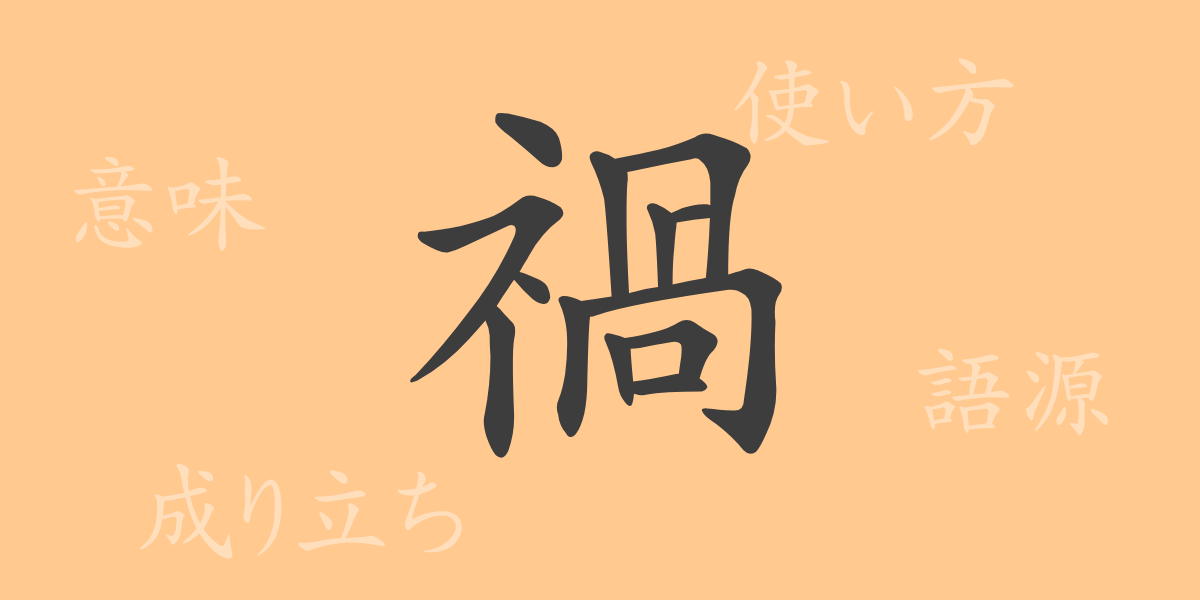
In the Japanese language, there exists a multitude of kanji characters, each with its own rich expressive power. Among these, the kanji “禍” (Wazawai) is often used to convey the gravity of emotions or situations. In this article, we delve deeply into the meaning, origin, and everyday usage of “禍” in our daily lives.
The Origin of 禍 (Wazawai)
The kanji “禍” has been used since ancient China to represent calamities and misfortune. This character includes the radical “示” (Simesu), which is related to rituals and prayers to the gods, suggesting that it evolved to signify misfortunes believed to be sent by the gods. The kanji’s formation was also influenced by the era’s belief that disasters and misfortunes were “warnings from heaven.”
The Meaning and Usage of 禍 (Wazawai)
“禍” refers to disasters, misfortunes, and calamities, particularly those that are beyond human control, such as natural disasters or unexpected accidents. It can also be used metaphorically to signify major trials or difficulties in life. Typically, it is used as a noun in combination with verbs, in phrases like “禍を招く” (Wazawai-wo-mane-ku, to invite disaster) or “禍を避ける” (Wazawai-wo-sa-keru, to avoid misfortune).
Reading, Number of Strokes, and Radical of 禍 (Wazawai)
Basic information about the kanji “禍” is as follows:
- Reading: The on’yomi (Chinese reading) is “か”(Ka), and there is no particular kun’yomi (Japanese reading).
- Number of Strokes: It has a total of 13 strokes.
- Radical: The radical is “示” (Simesuhen).
Idioms, Phrases, and Proverbs Using 禍 (Wazawai) and Their Meanings
There are many idioms, phrases, and proverbs that include the kanji “禍”. Here are some examples:
- 禍福は糾える縄の如し (Kahuku-ha-azana-eru-nawa-no-goto-si): A proverb meaning that fortune and misfortune are unpredictable and can come at any time in any form.
- 禍を転じて福となす (Wazawai-wo-ten-jite-huku-tonasu): Turning a disaster or unfortunate event into a favorable outcome or benefit.
- 禍根を残す (Kakon-wo-noko-su): Leaving the root of a problem unsolved, which may cause the problem to arise again later.
Conclusion on 禍 (Wazawai)
The kanji “禍” is a word well-suited to expressing the unavoidable disasters and trials in our lives. Its profound meaning deeply reflects the emotions and worldview of the Japanese people. How we perceive and handle “禍” in our daily lives is a moment that challenges each individual’s wisdom and strength. Through this kanji, we can deepen our understanding of how to confront life’s difficulties.