



“
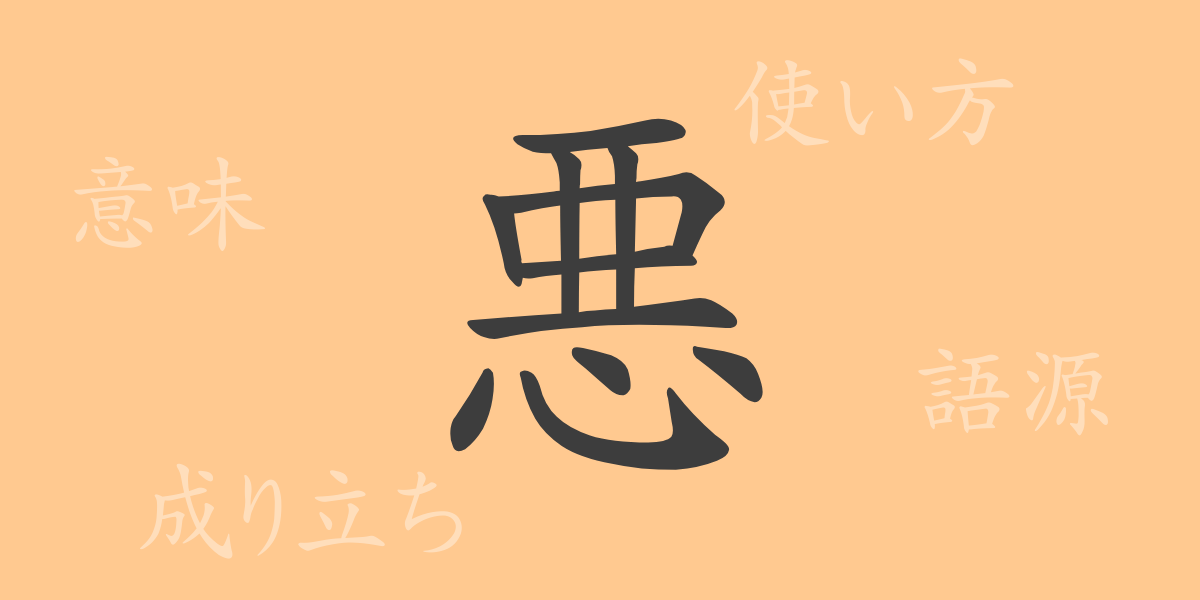
The Japanese language contains countless kanji (characters), each with its own unique history and meaning. The kanji “”悪”” (Aku) is frequently used in everyday life, yet it carries a deep cultural and historical background. In this article, we explore every aspect of the character “”悪””—its origin, meanings, usages, pronunciations, and the various idioms and compound words it appears in. Let’s delve into the world of “”悪”” (Aku) and uncover its linguistic and cultural power with an SEO-conscious perspective.
Origin of 悪 (Aku) – Etymology
The character “”悪”” (Aku) traces its roots back to ancient Chinese oracle bone script. Originally written as “”亜”” (A), the upper part depicted a roof symbol “”宀”” (Ukanmuri), while the lower part represented the heart “”心”” (Kokoro). Together, they conveyed the image of a troubled heart under a roof, symbolizing inner unrest. Over time, it came to represent moral or emotional imbalance and evolved into the modern form “”悪”” (Aku), still reflecting the negative aspects within human nature.
Meaning and Usage of 悪 (Aku)
The kanji “”悪”” (Aku) generally expresses negative moral or ethical conditions. It refers to actions, feelings, or situations that are wrong, harmful, or potentially dangerous. In Japanese, it is commonly used as the adjective “”悪い”” (Waru-i, bad), but also appears in compound words like “”悪化”” (Akka, deterioration), “”悪徳”” (Aku-toku, immorality), and “”悪用”” (Aku-you, misuse), functioning as both a noun and a verb modifier.
Readings, Stroke Count, and Radical of 悪 (Aku)
The character “”悪”” (Aku) showcases the depth of Japanese through its readings and structure:
- Readings: On’yomi : “”Aku””, “”O”” \; Kun’yomi : “”Waru-i””
- Stroke count: 11 strokes
- Radical: 心部 (Shin-bu, heart radical)
Common Idioms, Proverbs, and Compound Words Using 悪 (Aku)
The character “”悪”” (Aku) appears in a wide range of idioms and expressions, reflecting Japanese moral values and worldview.
Examples include:
- 悪因悪果 (Akuinakka): “”Evil causes lead to evil consequences”” — a concept of karmic retribution.
- 悪戦苦闘 (Akusenkutou): “”Struggling fiercely in a difficult situation”” — describing perseverance through hardship.
- 善悪の区別 (Zenakunokubetsu): “”The distinction between good and evil”” — used to express moral discernment.
Conclusion on 悪 (Aku)
The kanji “”悪”” (Aku) holds meaning far beyond its simple form. Through its shape, readings, and inclusion in countless expressions, it is deeply embedded in Japanese linguistic and cultural heritage. This article has explored the diverse roles that “”悪”” (Aku) plays in daily life and thought in Japan. Words often act as mirrors to the culture and history behind them, and by diving deep into just one kanji, we unlock a richer understanding of the Japanese language and its worldview.
“