



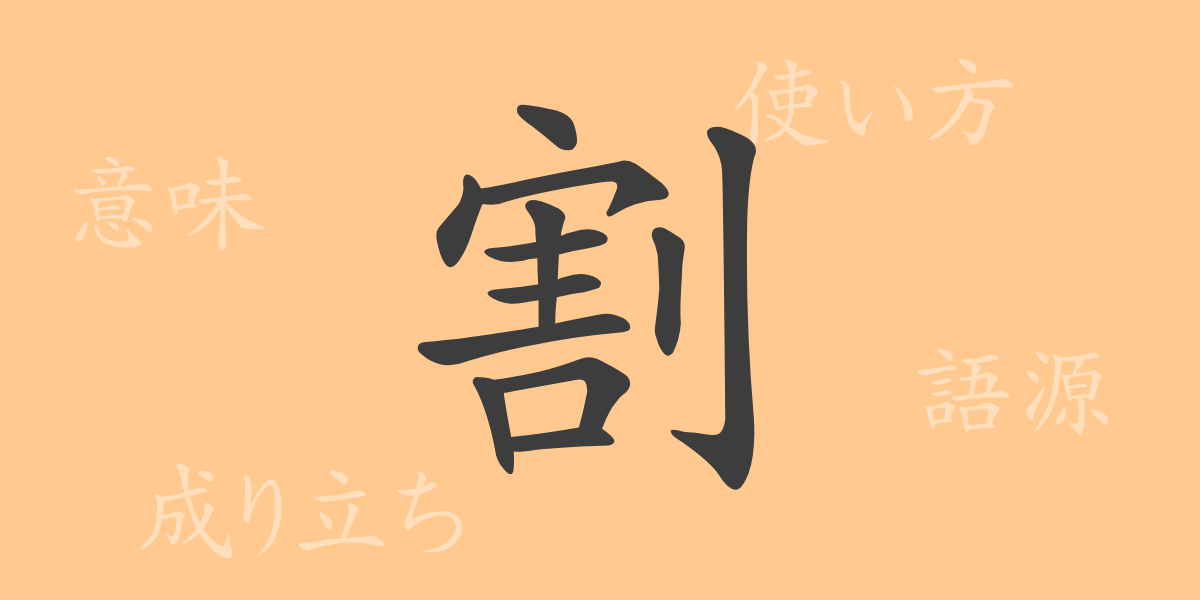
Each Japanese character has its own unique history and meaning. The frequently used kanji “割” (Wari) is no exception. This article delves deep into the world of “割” (Wari), from its etymology to its modern usage, and explores various idioms and proverbs. As we uncover the diverse aspects of “割” (Wari), let’s immerse ourselves in the depth of Japanese culture and language.
The Origins of 割 (Wari)
The kanji “割” (Wari) originated from ancient China, initially representing the act of “dividing something into two with a knife.” This pictographic meaning gave rise to concepts such as “to divide” and “to split,” which have since been used in various contexts. The shape is modeled after a knife entering an object, and it has evolved over time into its current form.
Meaning and Usage of 割 (Wari)
“割” (Wari) is used to indicate the act of dividing or splitting something, as in “to divide,” “to split,” or “to discount.” It is also used to express ratios and percentages, as seen in words like “三割” (さんわり, thirty percent) or “割合” (わりあい, ratio). Additionally, it appears in metaphorical expressions such as “気を割く” (Ki-wo-wa-ku, to be distracted) and “割を食う” (Wri-wo-ku-u, to suffer a loss).
Readings, Stroke Count, and Radical of 割 (Wari)
The basic information about the kanji “割” (Wari) is as follows:
- Readings: The on’yomi (Sino-Japanese reading) is “カツ” (katsu), while the kun’yomi (native Japanese readings) are “わる” (waru), “さく” (saku), and “わり” (wari).
- Stroke Count: “割” (Wari) is a kanji composed of 12 strokes.
- Radical: The radical of “割” (Wari) is the knife radical (Rittou), and it is categorized with characters that include the knife element.
Idioms, Phrases, and Proverbs Using 割 (Wari) and Their Meanings
There are many idioms, phrases, and proverbs that include “割” (Wari), showcasing the richness of Japanese expressions. Here are some examples:
- 割り箸 (Wa-ri-basi): Disposable chopsticks.
- 割り切る (Wa-ri-ki-ru): To resolve a problem or complex feelings in a straightforward manner.
- 割に合う (Wari-ni-a-u): To be worth the effort or cost.
- 割り込む (Wa-ri-ko-mu): To cut in line or interrupt.
- 割と (Wari-to): An adverb indicating relatively or to a certain extent.
- 割れ鍋に綴じ蓋 (Wa-re-nabe-ni-to-ji-buta): A proverb meaning that there is a suitable match for everyone.
Conclusion on 割 (Wari)
The kanji “割” (Wari) holds a significant place in Japanese communication due to its simple shape yet diverse meanings and uses. From everyday conversations to business settings and even in literary works, the spirit of “割” (Wari) is alive and well. The rich expressiveness of this single character tells a story of the depth of the Japanese language, continuing to play an important role in our words.